
Keeping your shower screen sparkling is a never-ending battle. Limescale builds up, soap scum clings on, and a stubborn white film settles on the glass. It works its way into the microscopic pores until the surface turns cloudy for good. It’s no wonder so many of us are looking for an escape and stumble upon the magic word: “nano”. But then the doubt creeps in. Will nano glass protection really save you hours of scrubbing, or is it just an overpriced bottle of mystery fluid when plain vinegar costs pennies? In this article, we’ll break down what nano glass protection can actually do, where the science ends and the marketing hype begins, and how to tell a product that works from a bottle of overpriced water.
Key takeaways if you're short on time
- Nano protection genuinely works, but it isn’t magic. It fills the microscopic pores in the glass to create a super-smooth, water-repellent layer, causing water to bead up and roll away.
- “Maintenance-free” is a myth. In hard water areas, minerals will still leave a fine, dusty residue when water evaporates. The coating simply means you can wipe it away with ease.
- Expect it to last 3 to 18 months. The lifespan depends on your water hardness, how often you shower, and, crucially, how you look after the treated surface.
- You can often spot cheap products by their smell. Harsh solvents can sting your eyes, whereas quality formulas use pure, specified alcohols (like ethanol) that evaporate cleanly.
- Preparation is everything. The glass must be completely free of limescale and grease before you start. If it isn't, the coating will bond to the dirt, not the glass, and wash away the first time you clean it.
How nano glass protection works (and why it isn't magic)
The principle behind nano glass protection comes straight from nature. The scientific basis for self-cleaning surfaces was described by the German botanist Wilhelm Barthlott back in 1997 — the so-called lotus effect. Lotus leaves stay perfectly clean even though they grow in muddy water, because their surface has a microscopic structure that water cannot cling to.
Glass is similar. It looks perfectly smooth, but under a microscope it resembles a mountain range, full of microscopic craters and valleys. Water, dirt, and minerals settle into these hollows, creating a stubborn film. Nano glass protection works by filling in those pores to create a continuous, invisible layer that dramatically lowers the surface energy of the glass. Water can no longer spread out; instead, it forms near-perfect beads that have minimal contact with the surface. Gravity then pulls them downwards, and as they roll, they pick up dust and soap residue along the way. This phenomenon is called beading, and you can recognise it by the contact angle of a droplet rising above 110 degrees, whereas on ordinary glass it sits below 40.
Here we have to be honest: the science of nano protection ends exactly where the exaggerated marketing promises begin. The water-repellent layer dramatically reduces the amount of dirt that can stick, but glass does not become immune to the laws of physics. If you let hard water dry on it, the water evaporates and the minerals are left behind — only now as a fine dust you can wipe away easily, instead of letting it bake on and etch into the glass itself.
Does it work, or is it just marketing? What people's experience says
Online cleaning forums are split into two irreconcilable camps. The first group has found a product that works and won't hear a word against it — the typical comment is usually something like, "Apply it once a year, then all you need is a cloth and a squeegee." These people have grasped the essence: the initial hour spent on careful application pays off many times over in the time they no longer waste scrubbing. For day-to-day maintenance, a quick wipe with a squeegee is all that's needed.
The second group feels cheated, and often for good reason. They complain about two things: an unbearable smell and zero durability. Reviews of cheaper alternatives repeatedly mention a sharp chemical odour that "stings the eyes" and forces you to ventilate the whole bathroom. On top of that come unrealistic expectations, fuelled by sellers who promise an absolutely maintenance-free shower. After three weeks, the customer spots dried droplets and writes the product off in disappointment. As seasoned forum users wryly note: the word "nano" doesn't guarantee effectiveness, only that the product is more expensive.
The truth lies somewhere in the middle. Nano protection works, but only if three conditions are met: you buy a quality product with a transparent ingredients list, you prepare the surface perfectly, and you accept that you'll still need to pick up a squeegee now and then. Let's walk through how to get it right.
How to tell quality nano glass protection from overpriced water
The first clue is the composition on the label. Cheap products use harsh industrial solvents as the carrier for the active ingredients to cut manufacturing costs to the bone — hence that pungent smell that irritates the airways. Quality alternatives use pure, specified alcohols, typically ethanol and propan-2-ol. These evaporate quickly and without residue, and they should also carry a UFI code that lets you trace the composition. You must always ventilate during application, because these are flammable substances, but a quality product shouldn't make your eyes sting.
The second clue is the manufacturer's honesty in the instructions. If someone promises a maintenance-free bathroom forever, they're misleading you. Instead, an honest manufacturer will be upfront that the layer has a limited lifespan, usually quoting a range of 3 to 18 months. That wide range isn't an excuse, but a reflection of reality: durability depends on your water hardness, how often you shower, and, most importantly, how you maintain the glass. A single use of an abrasive paste or aggressive degreaser can destroy a painstakingly applied layer in one go.

Editor's pick
Horewell Nano Glass Protection 100 ml
A water-repellent formula with a transparent ingredients list (ethanol and propan-2-ol, with a UFI code on the bottle). One pack treats 6–8 m², covering a large shower enclosure and your mirrors. No maintenance-free promises, just honest physics.
€20.50
View productThat’s the honest approach we look for, and it’s why we stock Horewell Nano Glass Protection. It uses pure ethanol and propan-2-ol as the carrier liquid, with the UFI code clearly stated, so you know precisely what you’re working with. Horewell is a partner brand we added to our range only after rigorous in-house testing — a policy we apply to all products, but especially to nanotechnology, where we reject far more formulas than we accept.

Preparing the glass: the step that decides everything
This is where most home attempts fall apart. Nanoparticles need direct contact with the structure of the glass to bond to it chemically. If you apply them to glass that still has even a thin film of limescale, they bond to that limescale — and the first time you clean the shower, you’ll wash the expensive coating straight down the drain along with it. The glass must, therefore, be perfectly clean and degreased before you begin.
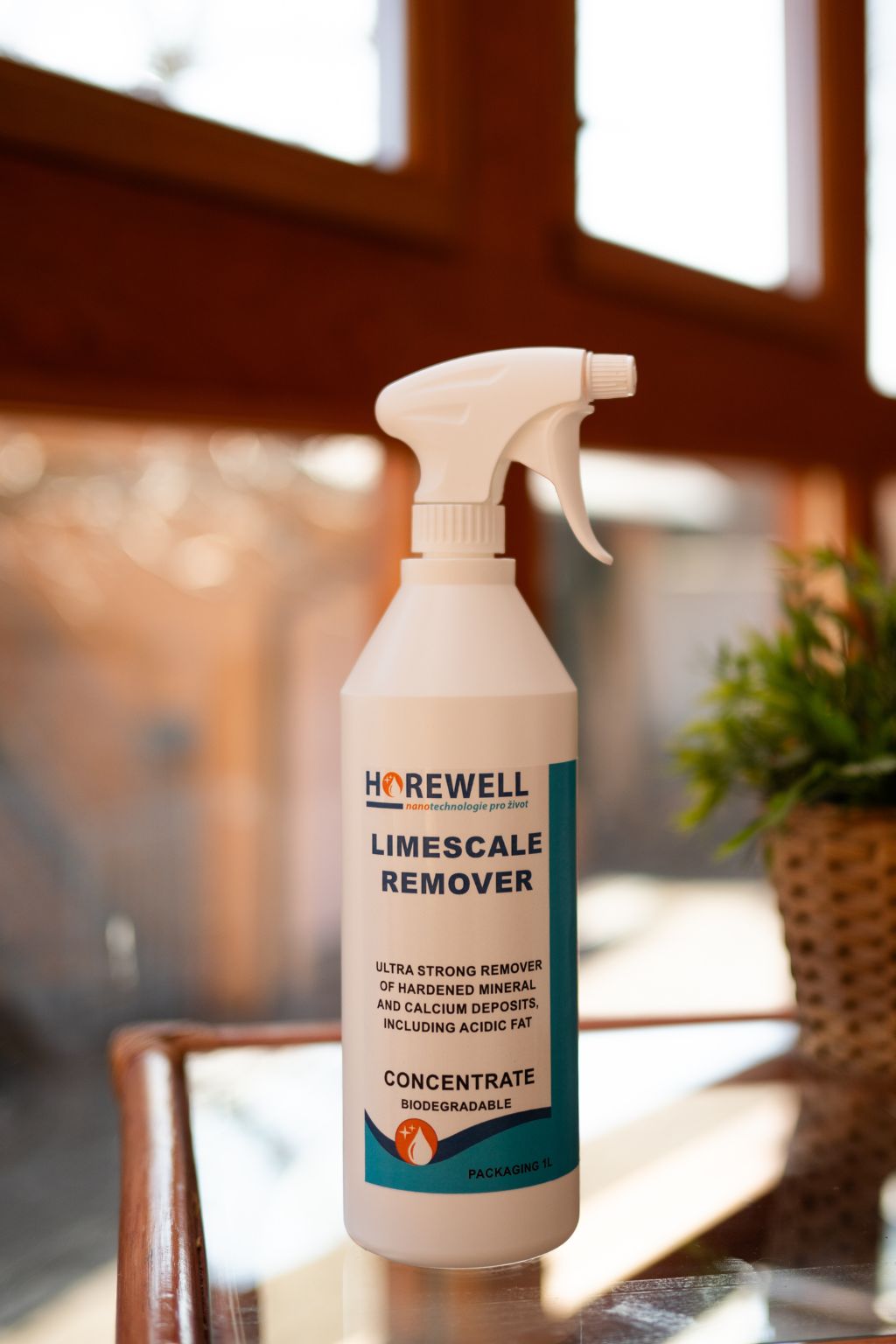
The process has three steps. First, remove the limescale; if it's ingrained, a Horewell Nano Limescale Remover helps. Then degrease the surface thoroughly so no residue remains. And only onto clean, dry glass do you apply the protection itself, using a sponge in long, overlapping strokes so you don't miss a single centimetre. After twenty minutes the first coat dries, you apply a second, and after another forty minutes you buff the surface with a dry microfibre cloth. It takes an hour, but the result lasts for months.
What you need to treat your glass
Maintaining treated glass: what to use and what to avoid
Once the protection is applied, one rule applies above all others: less is more. Ordinary bathroom cleaners contain strong acids or surfactants that can disrupt the delicate water-repellent layer or strip it off altogether. For day-to-day maintenance, clean water and a squeegee or a microfibre cloth are all you need — after showering, simply wipe the glass down and you're done. If you want to be on the safe side, reach for a pH-neutral maintenance cleaner, ideally from the same manufacturer, which is designed to support the coating rather than attack it.
The tool matters too. You'll ruin even the best nano layer with a rough sponge or a paper towel that scrapes across the glass. A professional microfibre glass cloth, on the other hand, traps dust and moisture inside its fibres, doesn't shed lint, and doesn't create micro-scratches. But the cloth needs care — wash it at 40 °C without fabric softener (which would coat the fibres in grease and ruin their absorbency) and don't tumble dry it. Treated this way, it will last for dozens of washes.
Vinegar and home remedies versus nano protection
"Hot vinegar is enough for limescale, you're wasting money on chemicals." You'll find this line under almost every cleaning discussion, and it holds a grain of truth — vinegar really does dissolve fresh limescale and it's cheap. But it confuses two completely different things: cleaning and protecting. Vinegar can clean the glass, but it cannot protect it. After cleaning with vinegar, the glass is just as porous as it was before, so fresh minerals will eat into it at the very next shower and the whole scrubbing cycle starts again.
That's the crucial difference. Home remedies treat the symptom; nano glass protection treats the cause. Vinegar, baking soda, or lemon juice are excellent for a one-off clean, but they only ever work until the water dries the next time. A nano layer, by contrast, seals those pores and creates a super-smooth surface where dirt and minerals struggle to get a foothold. So you're not comparing one small bottle with one bottle of vinegar — you're comparing it with dozens of hours of future scrubbing that you'll never have to do. The honest approach isn't "nano replaces cleaning". It's "nano follows cleaning".
Where else nano glass protection helps
A shower enclosure is the most common reason people reach for nano glass protection, but it’s far from the only place it can be useful. It works just as well on mirrors and windows, where it reduces condensation and fogging, so it’s ideal for a home wellness room or sauna too. It's also popular on the inside of car windows and on the windscreen, where it improves visibility in the rain. And if your scepticism about "nano" runs deeper, it's worth understanding the technology itself — we cover it in are nanotechnologies safe, in how nature is the world's best nanotechnologist, and in the piece on self-cleaning photocatalytic coatings.
Conclusion
So does nano glass protection work, or is it marketing? It works — but only for someone who approaches it with realistic expectations. It isn't a spell that abolishes cleaning forever, but it's honest physics that can turn gruelling scrubbing into a quick, satisfying wipe. All it takes is to choose a quality product with a transparent formula, spend an hour on careful preparation and application, and then maintain it with nothing but clean water and a soft cloth. Anyone expecting a miracle with no effort at all will be disappointed. Anyone who understands how it works, and what to expect from it, will be rewarded with glass that stays clear and is effortless to maintain for months or even years to come.
Frequently asked questions
Does nano glass protection mean I'll never have to clean the shower again?
No, that's the most common myth. The nano layer forms a shield that stops dirt and limescale from eating into the glass. Most of the water runs off on its own, but small droplets can remain. After showering, simply wipe the surface with a squeegee or microfibre cloth, and what used to be a major cleaning job becomes a simple wipe-down.
Why do some nano cleaners smell so awful?
Cheap products use harsh industrial solvents as the carrier for the active particles to cut manufacturing costs. Quality alternatives use pure, specified alcohols (like ethanol and propan-2-ol) that evaporate quickly and without residue. You must always ventilate, but a quality product shouldn't irritate your airways.
Can I apply the product straight onto glass that has a little limescale on it?
Absolutely not. Nanoparticles need direct contact with the structure of the glass. If you apply them over limescale, they bond to it, and the first time you clean it, you'll wash the coating away along with the dirt. The glass must be perfectly clean and degreased before application.
How long does nano glass protection last?
A range of 3 to 18 months is usually quoted. That wide range is down to real-world factors: durability depends on water hardness, how often you shower, and, most importantly, on how you maintain it. An abrasive paste or degreaser can destroy the layer in one go, whereas gentle upkeep with clean water extends its life considerably.
What happens if I use a regular bathroom cleaner on treated glass?
Ordinary cleaners contain strong acids or surfactants that can disrupt or wash off the water-repellent layer. For maintaining the treated surface, use only clean water, or a dedicated maintenance cleaner designed to support the coating, not strip it away.

Sources
- Barthlott, W., & Neinhuis, C. (1997) 'Purity of the sacred lotus, or escape from contamination in biological surfaces', Planta, 202(1), pp. 1–8.
- European Chemicals Agency (ECHA) — classification database and UFI codes, safe handling of ethanol and propan-2-ol.