
A musty smell from the fridge, mould in the cellar, the stale reek of cigarettes in a used car, or invisible bacteria clinging to a waiting room and a child's bedroom. All of these problems share one thing in common: ordinary cleaning and air fresheners simply cannot deal with them. Masking a smell is not the same as removing its cause. And this is exactly where an ozone generator comes in, a device that does not merely clean the air but treats the entire space, right down to the smallest cracks. In this article we will explain what an ozone generator is, how it works at the molecular level, what you can use it for, how to choose the right power output for your room, and how to use it so that it is both effective and completely safe.
Key takeaways if you're short on time
- An ozone generator produces ozone (O₃) from ordinary atmospheric oxygen and uses it to disinfect and deodorise the whole room, not just a stream of passing air.
- It destroys viruses, bacteria, mould and dust mites and breaks down odour molecules through powerful oxidation, so it removes the source of a smell rather than overpowering it.
- It reaches everywhere that water and a cloth never could, penetrating textiles, upholstery, ventilation ducts and the narrowest gaps.
- Once the cycle ends, ozone breaks back down into oxygen (O₂) on its own, leaving no chemical residue or deposits behind.
- The size of the space determines your choice, a small flat needs a different output than a hall or a hotel. And one safety rule always applies: no people, animals or plants may be present in the room during treatment.
What is an ozone generator?
An ozone generator, also called an ozoniser, is a device that uses active oxygen (O₃, ozone) to disinfect an entire space quickly, effectively and in an environmentally friendly way. It eliminates not only viruses, bacteria and mould, but also tackles odours and allergens, including the ever-present dust mites, which is something allergy and asthma sufferers and anyone with respiratory troubles will particularly appreciate.
Unlike a conventional air purifier, which pulls air through a filter and returns it to the room, an ozone generator fills the whole space with gas. That gas finds its own way into places you could never reach with a cloth or a spray. As a result, it treats not only the air but also the surfaces of objects. This makes it an excellent helper for the thorough disinfection of flats, offices, surgeries and other premises, as well as textiles, furniture, plaster and even children's toys.
It is important to understand that ozone is neither a perfume nor an air freshener. It does not cover a smell with a more pleasant scent, it chemically breaks down the very molecule that causes the odour. That is why it succeeds in situations where fragrances only mask the problem temporarily.
Tip: For more advice on removing damp and stale smells, take a look at our guide on how to remove odour and all bad smells from a car.
How does an ozone generator work?
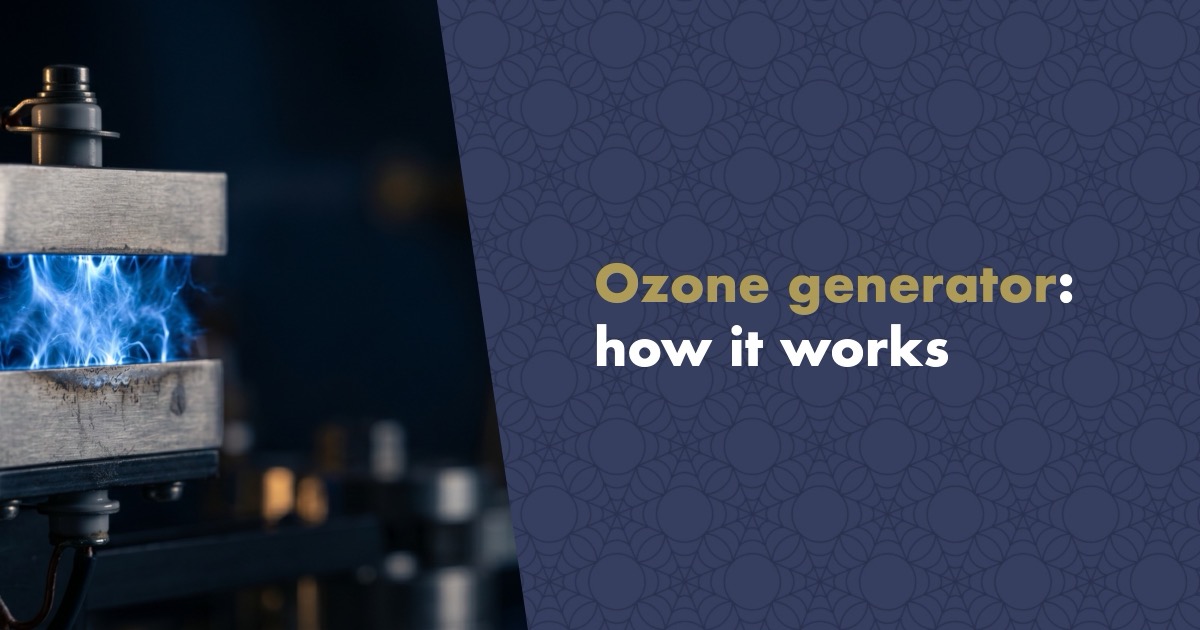
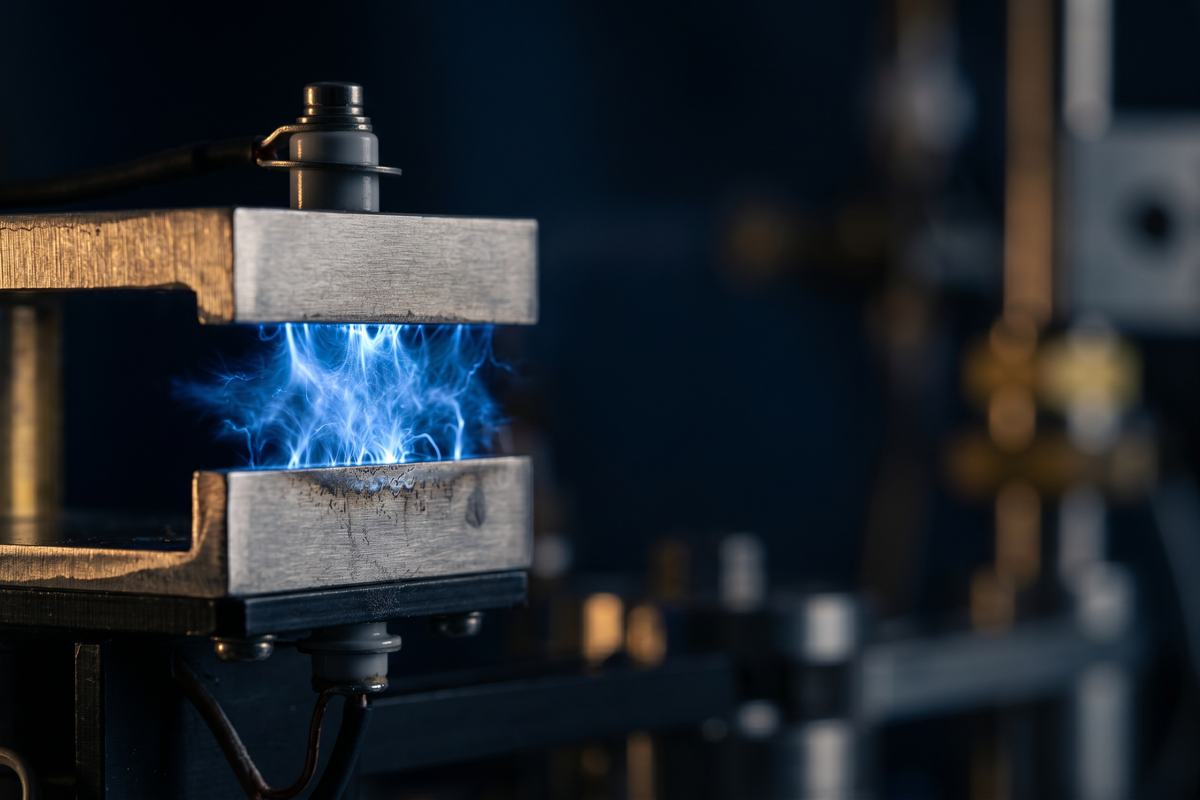
The whole secret lies in ozone itself. An ozone generator produces it from atmospheric oxygen (O₂) using an electrical discharge, most often a so-called corona discharge. During this process, oxygen molecules (O₂) are split into individual oxygen atoms (O). These then combine with another oxygen molecule (O₂), forming the three-atom molecule of active oxygen (O₃), ozone.
Ozone is one of the most powerful oxidising agents available to us. And because it is a gas, nothing escapes it. It permeates the entire interior, every corner and the tiniest crevice, it literally reaches everywhere. The mechanism of action is physico-chemical rather than "chemically toxic" in the way that sprays work: ozone collides with the cell wall of a microorganism, oxidises it and disrupts its integrity. In bacteria it ruptures the cell membrane; in viruses it damages the protein coat (the capsid) and the nucleic acid, so they lose the ability to multiply and survive.
Once ozone has finished its work, it is unstable and breaks back down on its own into the ordinary oxygen (O₂) we normally breathe. One physical fact matters here: ozone has a short half-life. At room temperature, roughly half of the ozone in the air decomposes in about 30 minutes, and even faster at higher temperatures. This is precisely why ozone disinfection leaves no residue, once the room is aired out, no chemical deposits remain, only clean air.
Tip: Worried about indoor air quality in general? Learn how an ozone generator complements the work you can read about in our article on how to get rid of mites in upholstery and mattresses.
What ozone destroys: viruses, bacteria, mould and odour
Ozone is among the most thoroughly studied disinfectants of all, used for more than a hundred years in drinking water treatment, for example. Its effectiveness is expressed scientifically by the so-called CT value, the product of concentration and contact time. The lower the CT value needed to kill a microorganism, the easier the disinfection. And ozone has very favourable figures.
Bacteria
Bacteria are among the most sensitive targets. With a common bacterium such as E. coli, inactivating 99% of the population takes only a fraction of a minute of contact with a low concentration of ozone. Ozonisation reliably reduces the presence of bacteria both in the air and on surfaces, which is why you will encounter it in healthcare, in the food industry and in the hotel sector.
Viruses
Ozone damages both the outer coat and the genetic information of viruses, so they lose the ability to reproduce. Studies confirm that a low concentration of ozone, given sufficient contact time, can significantly reduce the number of viable viral particles in a space and on surfaces. We are speaking of viruses in general here, ozone does not distinguish between types, it acts on all of them through the same oxidising mechanism.
Mould and fungi
Mould in the cellar, in a poorly ventilated bathroom or behind furniture is an unpleasant and unhealthy problem. Ozone destroys the spores of mould and fungi and, on top of that, removes the damp, musty smell that accompanies them. Solving the underlying cause of the moisture is always necessary at the same time, however, ozone alone will eliminate the mould, but if the damp remains, the problem will eventually return.
Odour and allergens
This is where ozone truly excels. It breaks down the molecules responsible for smells, whether that is animal odour, cigarette smoke, burnt oil, refuse or mustiness. At the same time it breaks down certain allergens and acts on dust mites, whose droppings are among the most common triggers of allergies and asthma. If you are battling mites in a mattress or upholstery, read on.
Tip: To learn how to prevent mites from building up in mattresses and how to deal with them simply, read our article on getting rid of mites in upholstery and mattresses.
You can use an ozone purifier almost anywhere
Ozone air purifiers are slowly but surely becoming indispensable helpers in many fields. In homes and offices they disinfect the air and surfaces and rid the space of odour. In surgeries, waiting rooms and pharmacies they destroy bacteria and viruses where many people gather, and in nurseries and other places where children spend time, they disinfect both the rooms and the toys. In cellars and basements they eliminate mould, fungi and the musty smell of damp; in restaurants and kitchens they remove the smell of food and burnt oil; and in hotels they clean an entire room, including odours from mattresses and curtains. They are also indispensable in cars, where they deal with mould from the air conditioning as well as smells from damp or cigarette smoke, and they prove their worth in public transport and industrial premises too.
Beyond that, ozone treatment is widely used in hospitals for disinfecting instruments and for sanitising machinery and surfaces in food-processing plants. It also has applications in ozonating food, where it helps to extend freshness, as well as on building sites, in water management, in cleaning swimming pools and in eliminating insect pests in grain silos. It is a versatile tool wherever you need to reliably remove microorganisms or odour from a large space all at once.
Tip: How to clean a car of unpleasant smells the easy way? Find out in our dedicated article.
How to choose an ozone generator: don't underestimate the decision
When you buy your own ozone generator, you gain the ability to live and work in a healthier, cleaner environment whenever you need to, without booking an outside company. You will also appreciate the quiet operation, low power consumption and light weight, so you can easily carry the device to wherever it is needed.
But how do you choose the right one? The decision depends above all on the size of the space you want to disinfect, and on how often you will use the device. A generator's output is given in milligrams of ozone produced per hour (mg/h). As a rough guide, an output of around 10,000 mg of ozone per hour is recommended for every 100 m² of space. It also holds true that a more powerful ozoniser will clean the same space faster than a weaker one.
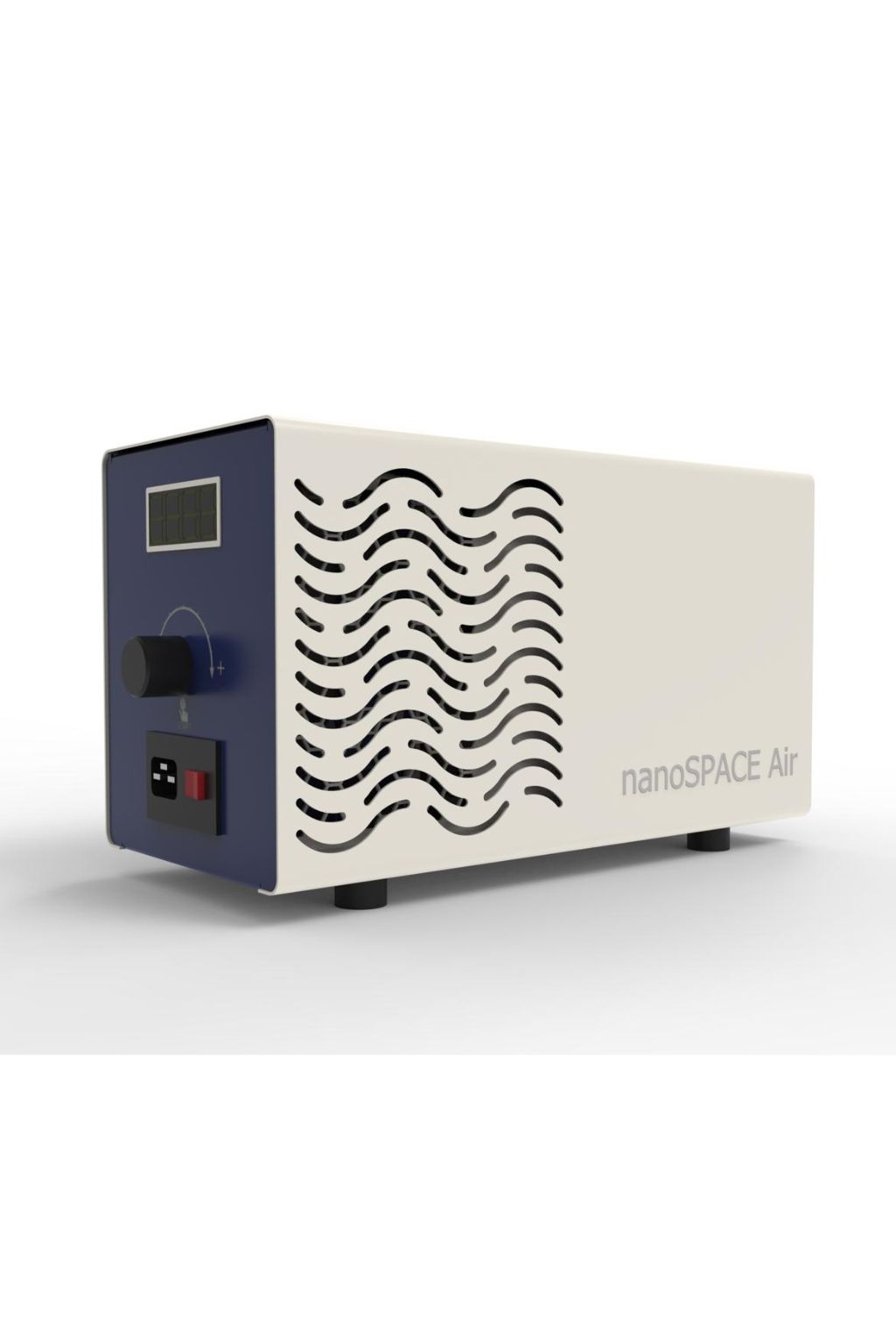
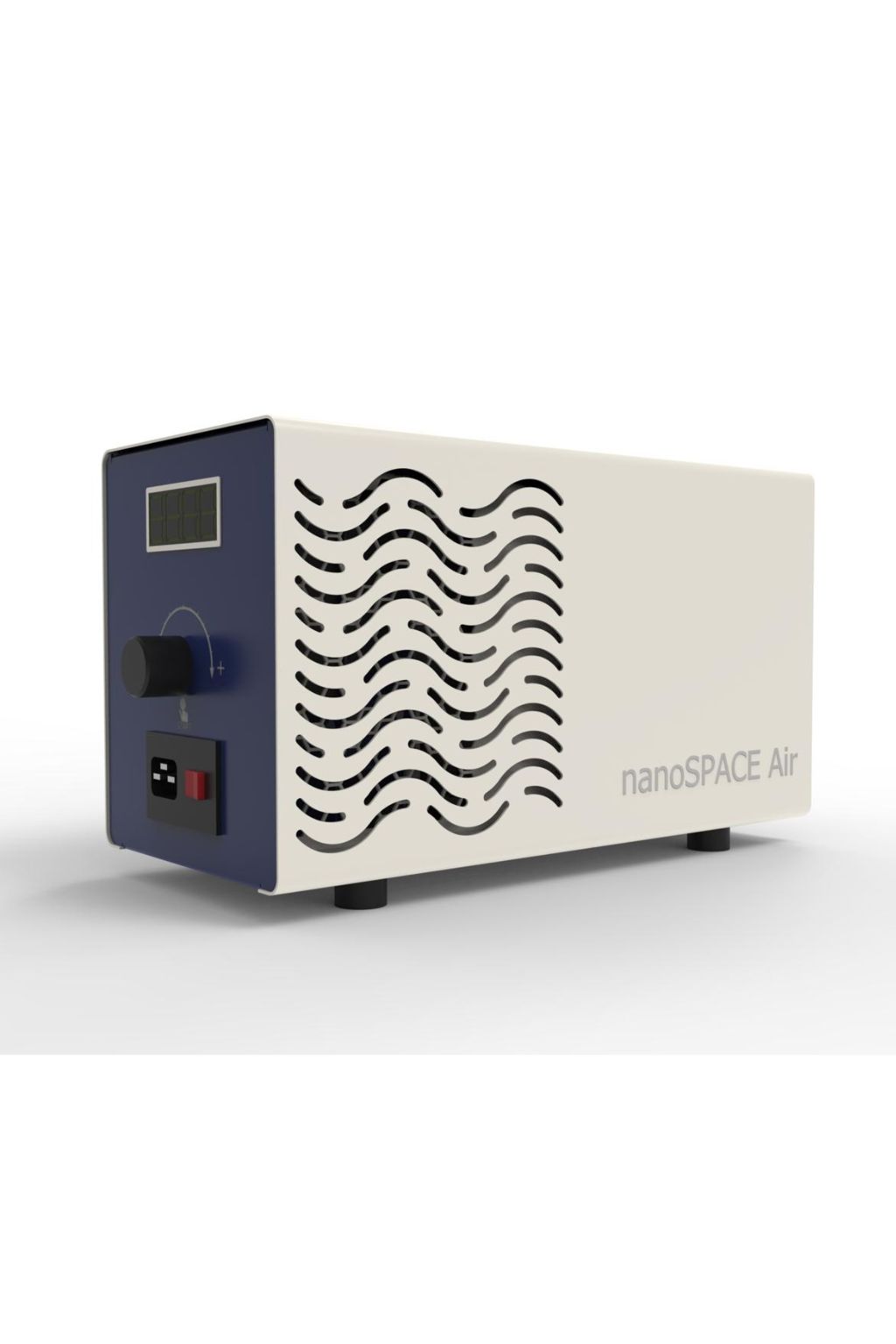
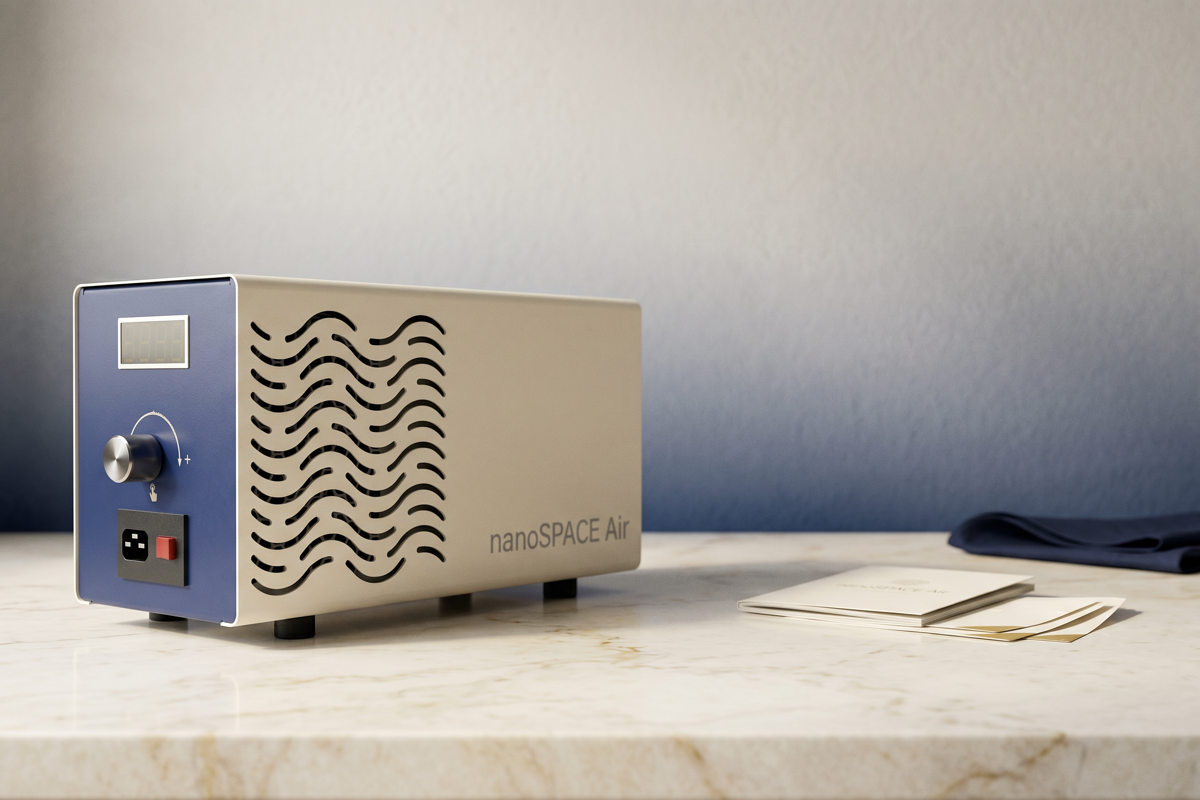
The second parameter worth looking at is an ozone destructor. Generators with a destructor actively break residual ozone back down into oxygen once the treatment ends, so you do not have to wait as long before re-entering the room. This is precisely the technology used by the nanoSPACE Air ozone generators, which we added to our range because of their combination of power, quiet running and rapid ozone neutralisation.
As a rough guide by room size:
► For smaller rooms up to roughly 30 m², such as flats, offices and children's rooms, the nanoSPACE Air 5 Destructor ozone generator is a good fit.
► For medium-sized spaces up to roughly 72 m², such as larger flats, surgeries and small premises, reach for the nanoSPACE Air 10 Destructor ozone generator.
► For large spaces up to 136 m², such as companies, hotels, halls and function rooms, the professional nanoSPACE Air 20 Destructor ozone generator is ideal.
nanoSPACE Air ozone generators with a destructor
How to use an ozone generator: a simple guide
The procedure for ozone disinfection is very simple. Even so, always follow the instructions for your specific device, which give you clear directions on how to proceed with ozonisation. In general, though, a handful of basic rules apply:
- The most important rule of all: during ozonisation there must be no people, animals or plants in the room.
- Before you start cleaning with ozone, tidy the space thoroughly, vacuum, mop and wipe down surfaces. Ozone delivers far better results on a clean surface.
- On the generator, set the cleaning time according to the size of the space, switch the device on, leave the room and close it off.
- After the cycle ends, do not enter the room for at least 1 to 2 hours and let the ozone break back down into oxygen. With devices that have a destructor, this waiting time is shorter, because they neutralise the residual ozone actively.
- Finally, air the space out carefully.
These rules are not a formality but a part of working safely. At higher concentrations ozone is an irritant gas, yet when the procedure is followed correctly it is entirely safe, because by the moment you step into the room it has long since broken back down into oxygen.
Tip: Read the details on the safety and possible risks of cleaning with ozone before you switch the device on for the first time.
Is ozone disinfection safe?
Yes, provided you follow the basic rules. The safety of ozone rests on a single principle: ozone should only be present in the room while nobody is in it. Regulatory agencies set a safe limit for residual ozone in the air at roughly 0.1 ppm. At higher levels, ozone can irritate the airways and mucous membranes and cause coughing or a headache, which is why the device is never used in the presence of people.
Fortunately, the physics of ozone takes care of this. Thanks to its short half-life, ozone rapidly turns back into ordinary oxygen once the device is switched off. After the recommended waiting period and airing, its concentration drops well below the safety limit, and all that remains in the room is clean, fresh air with no chemical residue. Devices fitted with a destructor shorten the whole process further, because they break down the residual ozone actively rather than waiting for natural decay.
How long does ozone disinfection take, and how long does it last?
The ozone air-cleaning process itself takes from a few minutes to 2 to 3 hours. It depends on the output of the ozoniser and the size of the space. A car interior is usually done in 10 to 30 minutes, whereas a large hall takes 2 to 3 hours, or several shorter cycles. As a general rule, the more powerful the ozone generator you choose, the faster the result.
You are no doubt also wondering how long an ozonated space stays clean. There is no simple answer to that, it depends very much on how intensively you use the space. It is really just like ordinary cleaning: as soon as you notice a smell, spot dirt or experience fresh contamination, treat the room with ozone again. Ozone does not work preventively into the future, it deals with the "here and now".
Conclusion: a healthier environment at the flick of a switch
Ozone purifiers have become a dependable ally in the fight against viruses, bacteria, mould and odour, against everything that lingers in ordinary spaces and that conventional cleaning does not resolve. Their great advantage is versatility: a single device serves you at home, in the car, in the office and on commercial premises, and once it has finished its work it leaves behind no chemicals, only clean oxygen. If living and working in a healthier environment is a priority for you too, an ozone generator is an investment that pays off in the form of cleaner air and calmer breathing. Choose the output to match the size of your space and follow the simple safety rules, you really do not need anything more.
Frequently asked questions
What does an ozone generator do?
An ozone generator produces ozone (O₃) from atmospheric oxygen and fills the whole room with it. Ozone is a powerful oxidising agent that eliminates viruses, bacteria, mould and dust mites while breaking down odour molecules. Once the cycle ends it breaks back down into oxygen on its own, leaving no chemical residue.
How do I choose the right ozone generator output?
The size of the space determines your choice. As a rough guide, around 10,000 mg of ozone per hour is recommended for every 100 m². A weaker model is enough for smaller rooms up to roughly 30 m², a medium output suits spaces up to 72 m², and a professional device is needed for large spaces up to 136 m². A more powerful generator cleans the same space faster.
Is ozone disinfection safe?
Yes, when the rules are followed. During ozonisation there must be no people, animals or plants in the room. After the cycle you wait 1 to 2 hours so the ozone can break back down into oxygen, and finally you air the space out. By the time you step into the room, the ozone concentration is well below the safety limit.
How long should ozone treatment last?
From a few minutes to 2 to 3 hours, depending on the output of the device and the size of the space. A car interior is usually done in 10 to 30 minutes, a large hall in 2 to 3 hours or across several shorter cycles. Always follow the instructions for your specific generator.
Does ozone remove the smell of a car or cigarettes?
Yes, very effectively. Ozone does not overpower a smell with fragrance; it chemically breaks down the very molecules that cause it, whether that is cigarette smoke, damp, mould from the air conditioning or animal odour. That is why an ozone generator is so often used when cleaning used cars and their interiors.

Sources
- Hudson, J. B., Sharma, M. and Vimalanathan, S. (2009) 'Development of a practical method for using ozone gas as a virus decontaminating agent', Ozone: Science & Engineering, 31(3), pp. 216–223.
- Arlian, L. G. and Platts-Mills, T. A. E. (2001) 'The biology of dust mites and the remediation of mite allergens in allergic disease', Journal of Allergy and Clinical Immunology, 107(3), pp. S406–S413.
- Nogales, C. G. et al. (2008) 'Ozone therapy in medicine and dentistry', Journal of Contemporary Dental Practice, 9(4), pp. 75–84.
- Gonçalves, A. A. (2016) 'Ozone as a safe and environmentally friendly tool for the seafood industry', Journal of Aquatic Food Product Technology, 25(2), pp. 210–229.
- Pumnuan, J., Insung, A. and Wangapai, T. (2020) 'The use of ozone for controlling European house dust mite, Dermatophagoides pteronyssinus (Trouessart)', Current Applied Science and Technology, pp. 420–428.