
Retinol is considered the gold standard of anti-wrinkle care — but not every complexion can take it, and not everyone is allowed to use it. Stinging, flaking and months when the skin looks worse than before are familiar to anyone who has tried it on sensitive skin. And during pregnancy and breastfeeding, retinoids are off the table entirely. Yet good care against the signs of ageing is not only about retinol. In this article we show what effective anti-ageing without retinol looks like: what to replace retinol with, why plant-based bakuchiol works, and who this route is made for.
Key takeaways if you're short on time
- Not every complexion tolerates retinol. It often irritates, stings and dries out sensitive, reactive skin, sometimes for several weeks.
- During pregnancy and breastfeeding, retinoids are off-limits. Medicines regulators advise against their use during this time.
- Bakuchiol is a plant-based alternative to retinol. Studies show a comparable effect on wrinkles and pigmentation, but with far less irritation.
- Anti-ageing without retinol works with other ingredients too — niacinamide, stable vitamin C or peptides, which do not irritate the skin.
- Results take time and consistency, not shock therapy. In return, they come without the stinging and flaking.
Why retinol doesn't suit everyone
Retinol is effective, there is no doubt about that. It speeds up skin renewal, supports collagen production and evens out skin tone. The catch is that the very mechanism behind its results is also the cause of its side effects. When you start using retinol, so-called retinoid dermatitis often appears — redness, stinging, flaking and peeling that can last four to eight weeks. Many people give up the treatment at precisely this stage, because their skin looks worse than when they began.
Frustration with retinol is one of the most common themes in skincare discussions. People describe breaking out in ways they had never seen before after weeks of use, or feeling as though every pore on their face was suddenly clogged. Some ride out the rough patch and reap the rewards; others give up and grow distrustful of anti-wrinkle products. The trouble lies not with their skin, but with the route they chose — and that can be changed. Effective care against wrinkles need not mean suffering. That is exactly why more and more people are looking for solutions without retinol.
Sensitive, reactive skin tolerates retinol the worst. If a strong active has ever damaged your barrier so badly that even plain water stung, you will know exactly what we mean. On top of that comes regulation: since November 2025, European legislation has limited the concentration of retinol in ordinary cosmetics to 0.3%, on account of the risk of an overall excess of vitamin A in the body, not because of the skin itself.
And then there is one group for whom the rule applies without exception: pregnant and breastfeeding women. Retinoids are not used at all during this period — medicines regulators list them among substances best avoided. This is precisely why interest in effective anti-wrinkle care without retinol keeps growing, care that pleases sensitive skin and mothers-to-be alike.
Bakuchiol: a plant-based alternative to retinol
Bakuchiol is an extract from the seeds of the Psoralea corylifolia plant, and in recent years it has become a standout in retinol-free skincare — and deservedly so. Chemically it has nothing in common with retinoids, yet in skin cells it triggers similar processes, so it brings the skin a comparable anti-ageing effect. The difference is in tolerability. A double-blind study compared 0.5% bakuchiol with 0.5% retinol over twelve weeks, and both ingredients reduced the area of wrinkles and hyperpigmentation to a comparable degree. Retinol, however, caused significantly more peeling and stinging.
Bakuchiol also has two practical advantages. It is photostable, so unlike retinol it is not destroyed by daylight and can in theory be used during the day as well. And it does not trigger inflammatory cascades, so even sensitive, reactive skin can handle it, the kind that otherwise cannot tolerate strong actives. You do not have to spend ages getting your skin used to it — it works for you from the very first application, without disrupting its protective barrier. If you would like to know more about this ingredient, we have a separate look at how to achieve perfect skin with vitamin A and the retinoid family.
This combination of effectiveness and gentleness makes bakuchiol the foundation of a thoughtfully formulated anti-ageing serum with bakuchiol. The serum works at night, when the skin has room to recover, and supports it in producing its own collagen — not by delivering collagen into the deeper layers (the molecule is far too large for that), but by sending the skin a signal to make it itself.
What can you expect from bakuchiol, and what not? It smooths fine lines, evens out tone and gradually firms the skin, much like retinol but more gently and without the drama. It will not turn mature skin into that of a twenty-year-old, nor iron out deep wrinkles overnight — no cosmetic can. Its strength lies in the fact that you will want to use it long-term, because it will not drive you away with unpleasant side effects. And in anti-ageing, long-term use is what matters most.
What else gentle anti-ageing care can do
Bakuchiol is not the only ingredient that good retinol-free care rests on. Its strength shows above all in combination with other gentle actives that complement one another. Niacinamide, or vitamin B3, strengthens the skin barrier, regulates oil and brightens pigmentation — and all without the irritation retinol is known for. A stable derivative of vitamin C adds antioxidant protection and supports collagen production, but unlike pure ascorbic acid it does not sting or oxidise, so it suits sensitive skin too. And anti-inflammatory oat extracts, the avenanthramides, soothe reactive skin.
Alongside them sit patented active ingredients which, according to the manufacturers' clinical tests, support collagen production and the smoothing of wrinkles. Treat these results as figures from ingredient suppliers, not as general dermatological truth — but even so they point in the direction modern care without retinoids is taking. What all these ingredients have in common is that they work with the skin, not against it. Instead of an aggressive intervention, they choose the path of gradual but steady renewal.
How to combine non-retinoid ingredients
One advantage of this gentler route is that its ingredients get along well with one another. Bakuchiol, niacinamide and stable vitamin C can happily be used together without cancelling each other out or irritating the skin. Niacinamide suits the morning routine, where it strengthens the barrier under sunscreen. A bakuchiol serum belongs to the evening, when the skin renews itself. And vitamin C in a derivative form is fine morning or night. If you add gentle exfoliating acids, give them a different day from the stronger actives and let the skin recover. It is not about putting as much as possible on your face, but about combining a few things that work well together.
Anti-ageing without retinol from nanoSPACE
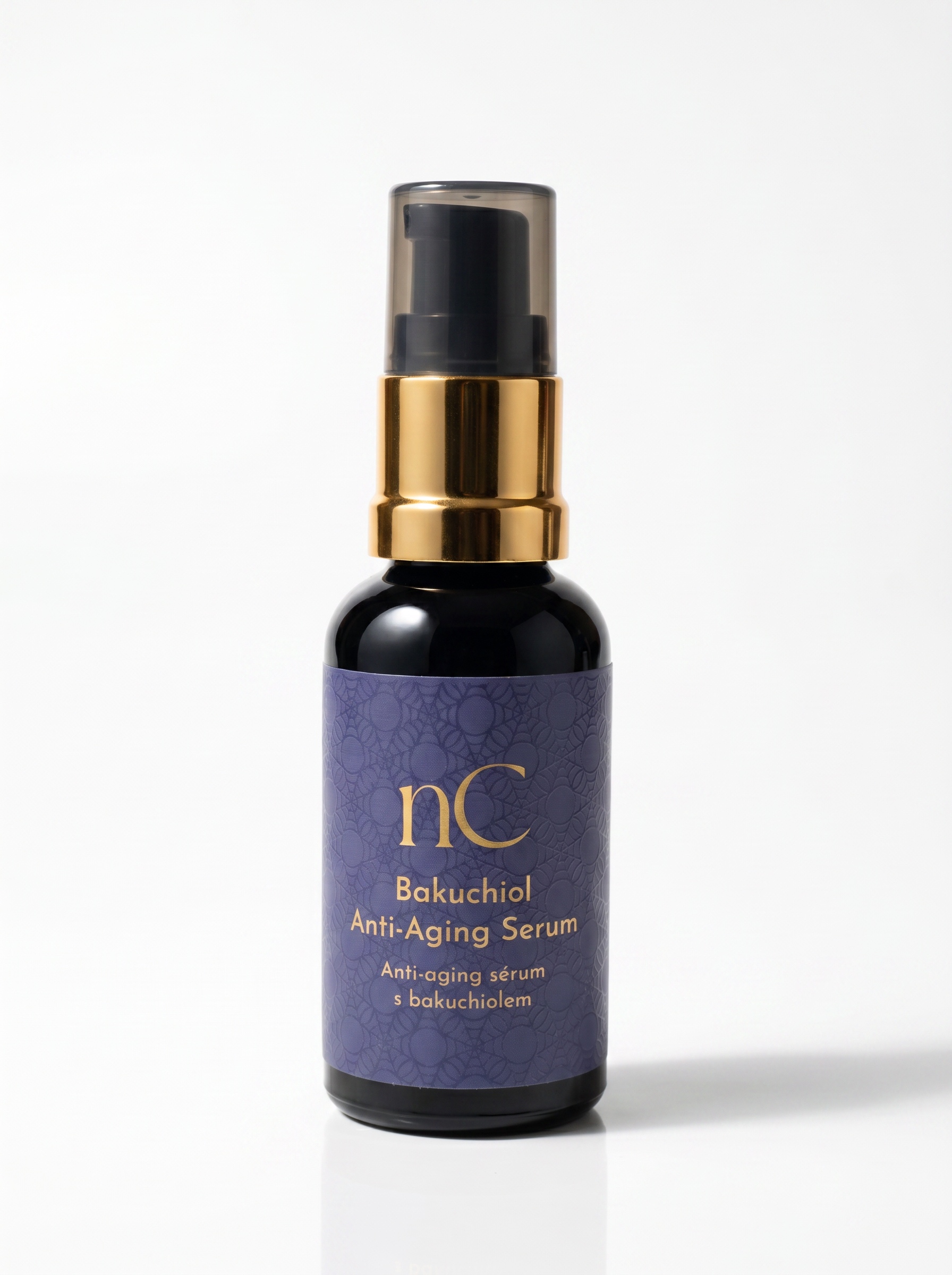
Anti-Aging Serum with Bakuchiol
A night serum with bakuchiol for sensitive skin that wants results without the irritation of retinol.
View productWho care without retinol is made for
Anti-ageing without retinoids appeals to several groups. Most often it is people with sensitive, reactive skin, whose barrier retinol breaks down and who are looking for care that will not sting and dry them out. It also suits those who tried retinol and gave up because of the long, uncomfortable period of irritation. And people reach for it who simply prefer a gentle approach to strong actives.
It is also worth it for those just starting with prevention, who do not want to reach straight for the strongest option. Bakuchiol is an ideal gateway into anti-ageing: it gives visible results, but it won't hit your skin with the side effects that make people give up after a few weeks.
Pregnant and breastfeeding women are a group of their own. Bakuchiol is not a retinoid, so it is often the choice of women who want to avoid retinol during this time. The important thing, though: any cosmetic during pregnancy is not a decision you should make on your own — always consult your doctor or pharmacist, who knows your situation. We cannot replace their recommendation; we can only show that an effective route without retinol exists. If you are curious about the other side of the coin, read more about how to prevent wrinkles in general.
How to add a bakuchiol serum to your routine
The bakuchiol serum belongs to your evening care, when the skin recovers undisturbed. Apply it to cleansed, dry skin — a few drops are enough. Let it absorb for a moment, then seal your care with a hydrating or nourishing cream that locks the actives into the skin. Unlike retinol, bakuchiol needs no lengthy every-other-day breaking-in; most people tolerate it without trouble from the first application.
A few principles are worth following, though. Introduce new products one at a time and give the skin two to four weeks before you judge how it reacts. Don't needlessly pile on several strong actives at once; a bakuchiol serum is plenty on its own. And even though bakuchiol is photostable, always protect your skin with sunscreen in the morning — without sun protection any anti-ageing care loses its point, because UV is the greatest destroyer of collagen. You will find a complete overview of anti-wrinkle care in our article on the best collagen for hair and skin.
Common myths about anti-ageing without retinol
The most common myth is to expect a miracle overnight. No active ingredient, neither retinol nor bakuchiol, will smooth wrinkles in a few days. Healthy, firm skin does not come from shock but from steady care — results arrive with regularity, over a matter of weeks. Anyone who gives up after a few days robs themselves of the result just as it is about to arrive.
Another widespread belief is that "without retinol" means "without effect". Studies and practice show the opposite: a well-composed non-retinoid routine delivers comparable results, just by a gentler route. And just as common is skipping sun protection in the belief that an evening serum is enough. It is not. Anti-ageing is always a partnership of effective evening care and diligent morning protection — one without the other does not work.
Conclusion
Retinol is excellent, but it is not the only route, and for some people it is no route at all. Sensitive skin, a bad experience with irritation or pregnancy are all good reasons to look for effective anti-ageing without retinol — and that exists today. Bakuchiol offers a comparable effect on wrinkles and pigmentation with far less irritation, and even sensitive, reactive skin can handle it. Together with niacinamide, vitamin C and peptides it makes up care the skin can take long-term. Just give it time, consistency and morning sun protection. You will not stop wrinkles entirely, but you will slow them down in a way your skin can bear — without the stinging, flaking and months when it looks worse than before. And that is what matters most in everyday skincare.
Frequently asked questions
Is bakuchiol really as effective as retinol?
According to a double-blind study comparing 0.5% bakuchiol and 0.5% retinol over twelve weeks, both ingredients reduced the area of wrinkles and hyperpigmentation to a comparable degree. Retinol, however, caused noticeably more peeling and stinging. Bakuchiol therefore offers a comparable effect with better tolerability.
Can I use bakuchiol during pregnancy?
Bakuchiol is not a retinoid, so women often reach for it during pregnancy instead of the prohibited retinoids. No cosmetic during pregnancy is a decision you should make alone, though — always consult your doctor or pharmacist, who knows your situation.
Do I have to break in bakuchiol the way I do retinol?
No. Unlike retinol, which requires gradual every-other-day introduction and is often accompanied by weeks of irritation, most people tolerate bakuchiol without trouble from the first application. It does not cause the typical retinoid stinging or flaking.
Do I still need sunscreen with non-retinoid care?
Absolutely. UV is the main cause of skin ageing and collagen loss, so without morning protection with SPF any anti-ageing care loses its point. This applies to retinol and to non-retinoid ingredients including bakuchiol alike.
How long until I see results?
Count in weeks, not days. The first signs of finer, more even skin tend to show after several weeks of regular evening use, while more pronounced changes in wrinkles and pigmentation come after roughly two to three months. The secret is perseverance and daily sun protection.

Sources
- Dhaliwal, S. et al. (2019) 'Prospective, randomized, double-blind assessment of topical bakuchiol and retinol for facial photoaging', British Journal of Dermatology, 180(2), pp. 289–296.
- European Commission (2024) Regulation (EU) 2024/996 amending the restriction of vitamin A (retinol) in cosmetic products.