
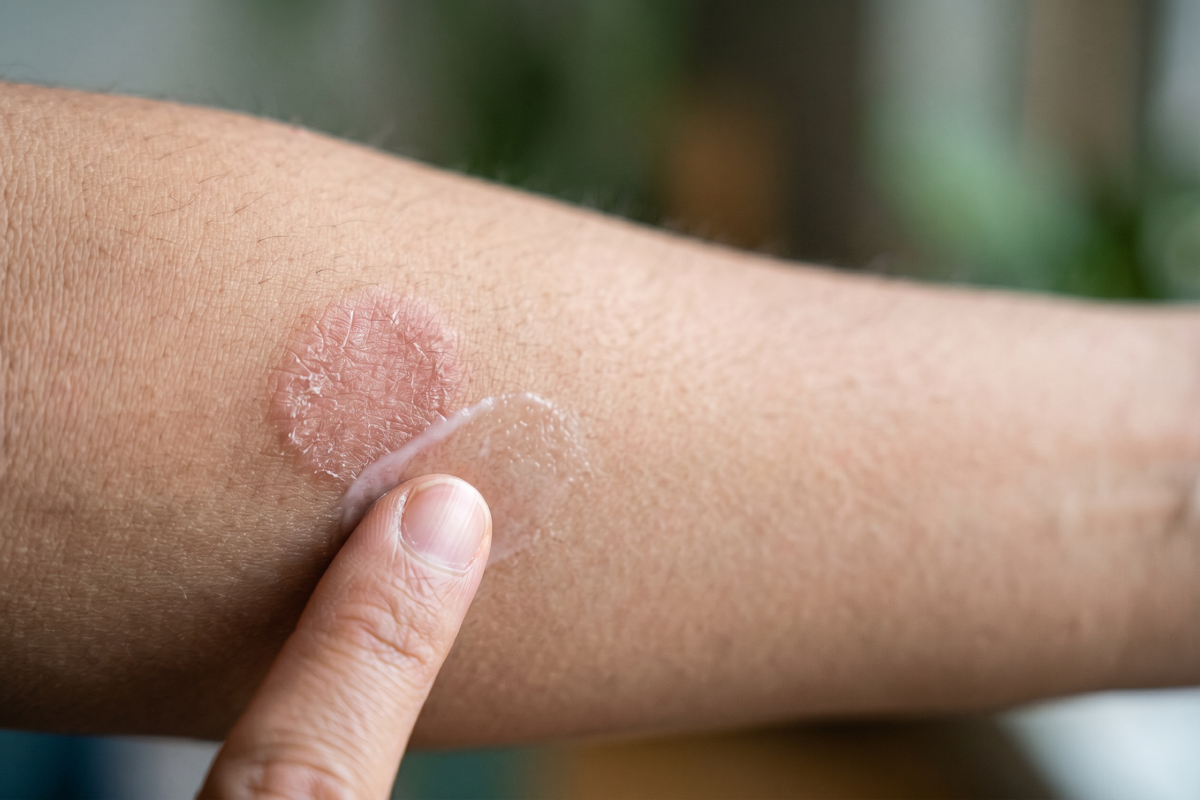
A round, sharply defined, red patch appears on a shin, forearm or the back of a hand – it resembles a coin, itches, weeps and simply won't budge. The first thing most people (and often doctors) think of is a fungus. And that's exactly where the problem starts. Nummular eczema (from the Latin nummus, a coin), also known as discoid eczema, looks strikingly like ringworm – but it's an entirely different disease that needs entirely different treatment. Mix the two up, however, and you can do real harm. In this article, we'll explain what nummular eczema is, why it develops, how to tell it apart from a fungal skin infection and what actually helps to soothe it.
Main takeaways if you're short on time
- Nummular eczema forms coin-shaped patches. They are round, sharply defined, itchy and often weeping. They appear most often on the limbs.
- It's the "twin" of atopic eczema. Modern studies have shown it isn't a standalone mystery but a variant of atopic dermatitis with an added mix of features typical of psoriasis.
- The main trigger is dry skin. In up to two-thirds of patients, severe dryness (xerosis) is the starting point; the condition therefore worsens mainly in winter.
- Be careful not to mistake it for a fungus. It looks like tinea (ringworm) but is treated in entirely the opposite way. Applying a steroid to an unrecognised fungal infection can make it worse and cause it to spread.
- The foundation of care is moisturising. Emollients restore the barrier; for inflammation, a doctor may prescribe corticosteroids or, in severe cases, modern biologic treatments.
Disclaimer: This article is for information only and is not a substitute for medical advice. We at nanoSPACE are not doctors. Because nummular eczema is easily mistaken for a fungus, always leave the diagnosis and treatment to a dermatologist – don't apply any corticosteroid cream on your own.
What Nummular (Discoid) Eczema Is
The name gives the game away. The Latin nummus means a coin, and that's exactly what the patches look like: round, sharply defined areas ranging from the size of a small coin upwards. They tend to be deep red, often developing tiny blisters that weep and eventually crust over. They also itch intensely – especially in the evening and at night, disrupting sleep and making it incredibly tempting to scratch. They form most often on the shins, forearms and backs of the hands, but can appear anywhere.
For a long time, nummular eczema puzzled dermatologists, who treated it as a non-specific inflammation "of unknown cause". Modern research has completely overturned that view. A large 2023 study (Bohner et al., JACI), based on an analysis of skin samples, aptly renamed nummular eczema the "neglected twin" of atopic dermatitis. It turned out to be not a standalone disease but a specific variant of atopic eczema, with the difference that it also carries features typical of psoriasis (the inflammation is driven by two different branches of the immune system at once). It's that "psoriatic" component that explains why the patches tend to be thicker and harder to manage than ordinary atopic eczema. Specifically, nummular eczema shares with atopic eczema a broken skin barrier, a tendency to be colonised by Staphylococcus aureus (a bacterium, often simply called staph, that settles on damaged skin and worsens the inflammation) and swelling between the cells, while it shares with psoriasis a pronounced thickening of the skin and accelerated skin-cell turnover. This hybrid nature makes it a tougher nut to crack than classic atopic eczema.
The demographics of who develops the condition are interesting, too. Unlike atopic eczema, which dominates in childhood, nummular eczema has two age peaks: young women between 15 and 25, and men in later middle age (50–65). The average age at diagnosis is around 47, and it's slightly more common in men (roughly 57% of cases). It's neither incredibly rare nor extremely common – prevalence estimates vary widely by population, with German data from 2022 putting it at roughly 0.07 to 0.26% of the population. These two groups probably have different triggers – hormones likely play a role in younger patients, while years of wear and tear on the skin barrier affect the older group.
Why Nummular Eczema Develops and What Triggers It
As with most eczemas, it starts with a damaged skin barrier. When the protective lipid layer stops working, irritants and allergens easily get in, inflammation flares up, and the skin defends itself by thickening. For this underlying tendency to erupt into full coin-shaped patches, however, it usually needs a trigger. And the primary culprit is clear.
| Trigger | Why it worsens nummular eczema |
|---|---|
| Dry skin (xerosis) | The primary trigger – the starting point for up to two-thirds of patients |
| Winter and dry air | Freezing outdoor temperatures and overheated interiors draw moisture out of the skin |
| Harsh washing | Alkaline soaps, foaming gels with sulphates and hot baths disrupt the lipid film |
| Minor injury | An insect bite, scratch or graze can trigger a new patch (known as the Koebner phenomenon) |
| Bacteria and allergens | Staph bacteria and contact allergens (such as nickel) drive the inflammation further |
The fact that dry skin is the number one trigger is good news for you – it's the one factor you have the most control over. We've written about how to care for dry skin in our article on asteatotic eczema, which has a great deal in common with this "dry" origin.
Beware: It Isn't a Fungus! How to Tell Nummular Eczema from Tinea
This is a crucial distinction. Because of its circular shape, nummular eczema is regularly mistaken for tinea corporis, commonly known as ringworm. And because the two diseases are treated in practically opposite ways, the mix-up can cause real problems.
The main clue lies in the edges and the centre of the patch. Ringworm typically has an active, raised edge and a paler, healing centre (hence the ring-like impression). Nummular eczema, by contrast, is inflamed evenly across the entire "coin", often weeping and forming crusts. However, only a mycological test (a skin scraping) performed by a doctor can provide complete certainty.
Why does it matter so much? If you mistakenly use an antifungal cream on nummular eczema, it won't help and may irritate the skin further. Conversely – and far more dangerously – if you apply a strong steroid to an unrecognised fungal infection, the surface inflammation might visibly disappear, but the fungus will spread secretly and much more aggressively into the deeper tissues (a condition dermatologists call tinea incognito). So, there is a golden rule: never apply a steroid to a circular patch based on guesswork. There must be a clear diagnosis first. Ringworm isn't the only lookalike, either – heavily thickened patches can be confused with psoriasis, and weeping ones with contact dermatitis. That's another reason a definitive verdict belongs in a dermatologist's hands, not on an internet forum. If you're not sure what's behind a rash, our overview of what to look for in skincare for eczema-prone skin may help.

Editor's pick
AtopCare Body Cream 330 ml
Because dry skin is the number-one trigger of nummular eczema, daily moisturising is the foundation of care. This nourishing cream with colloidal oat, coconut and almond oil supports the restoration of the skin barrier, has a natural composition and the "For allergy sufferers" label. It complements treatment from a doctor; it doesn't replace it.
€22
View productHow Nummular Eczema Is Treated
Managing the condition is a long game and, because of the thickened patches, tends to be more difficult than with ordinary atopic eczema. It relies on a tiered approach, guided by a dermatologist.
The absolute foundation is intensive moisturising – emollients must be applied frequently and generously to compensate for the compromised skin barrier. To tackle the inflammation itself, a doctor will typically prescribe strong topical corticosteroids; weaker preparations (like hydrocortisone) often struggle to penetrate the thickened skin. Once the worst of the inflammation and weeping has subsided, calcineurin inhibitors (such as tacrolimus or pimecrolimus) may come into play; these don't thin the skin and are well-suited for maintenance care. For widespread outbreaks, narrowband UVB phototherapy can be beneficial.
When topical treatments aren't enough, systemic therapy may follow. This can include short courses of oral corticosteroids to control an acute flare-up, or, for long-term management of severe forms, immunosuppressants (drugs that dampen an overactive immune response) such as methotrexate or ciclosporin. For the most severe cases, modern biologic treatments – injectable drugs that precisely target inflammatory signals – are also an option. Interestingly, reclassifying nummular eczema as a relative of atopic dermatitis is exactly what opened the door to the biologic drug dupilumab. In one case report, it led to complete skin clearance, with the effects lasting for a year. Apremilast (a tablet proven effective for psoriasis), by contrast, yielded disappointing results for nummular eczema in a double-blind study – suppressing the "psoriatic" pathway alone simply isn't enough to tame this mixed inflammation. The specific treatment plan, however, is always a doctor's decision – this overview is purely for informational purposes.
Prevention and Everyday Care
Because dry skin is the primary trigger, a large part of managing the condition is in your own hands. A few simple rules can make a big difference:
- Moisturise generously. Regular use of emollients replenishes the skin barrier and reduces the risk of a fresh outbreak – a body cream works well all over, while an AtopCare body oil is better for the driest areas.
- Wash gently. Skip the hot baths and alkaline soaps; reach instead for a mild cleansing foam free from harsh surfactants.
- Humidify the air in winter. The central heating season is notoriously tough on discoid eczema – keeping your bedroom humidity at around 50% can work wonders.
- Protect your skin from injury. Even a minor insect bite or graze can set off a new patch.
- Don't treat circular patches based on guesswork. If a new "coin" appears, see a doctor first to rule out a fungal infection.
We've covered in detail what to look for in the ingredients of soothing, nourishing skincare in our overview of active ingredients for eczema-prone skin.
Everyday Care for Dry, Eczema-Prone Skin

What People with Nummular Eczema Most Often Struggle With
On patient forums, the same frustrations crop up time and again – and each perfectly reflects how the disease behaves. "It looks like a fungus, but it isn't" is the most common complaint; people often describe how doctors repeatedly prescribed antifungal creams to no effect. "Circles that weep and won't clear up" highlights the stubborn nature of the patches, which often start as an innocent-looking spot after a mosquito bite. "The steroid works, but then it comes back" is a classic illustration of what happens when maintenance care is skipped. As soon as a person stops moisturising after a patch fades, the compromised barrier and naturally occurring skin bacteria allow the inflammation to return straight away. And "it always gets worse in November" simply confirms the massive role that winter weather and dry indoor air play. The common denominator in all these stories is clear: nummular eczema is persistent and punishes inconsistency. Understanding that regular moisturising is an absolute necessity, rather than an optional extra, is half the battle.
Conclusion: The Right Diagnosis and Persistent Moisturising
Nummular eczema is no longer a mystery. We now know it's a more aggressive relative of atopic eczema that likes to masquerade as a fungal infection – and therein lies the catch. The first and most important step is getting the right diagnosis from a dermatologist, rather than experimenting with creams at home. Once the diagnosis is clear, the rest comes down to persistence. Generous moisturising, gentle washing and treating the inflammation under a doctor's supervision can successfully calm the coin-shaped patches. And because dry skin is the number one trigger, diligent barrier care is the best preventative measure you have. If new coin-shaped patches appear, don't waste time trying out random creams. The sooner the correct diagnosis is made, the faster your skin will settle, and the lower the risk that a single circle will turn into a map of patches across your body.
Frequently asked questions
How do I tell nummular eczema from ringworm?
By eye alone, it's incredibly tricky. The main clue is that ringworm typically has an active, raised edge and a healing, paler centre, whereas nummular eczema is inflamed evenly across the entire area and often weeps. Only a mycological test at the doctor's clinic can provide absolute certainty, so never apply a steroid to circular patches based on guesswork.
Is nummular eczema contagious?
No. Unlike the ringworm it is so often mistaken for, nummular eczema isn't transmissible. It is an inflammatory skin condition linked to a damaged skin barrier and dryness, not an infection you can pass to someone through touch or a shared towel.
Why does my nummular eczema keep coming back, mainly in winter?
Because the primary trigger is dry skin, and winter weather exacerbates it. Freezing temperatures outdoors and overheated, dry air indoors draw moisture out of the skin; the barrier weakens, and the patches return. Stepping up your moisturising routine and humidifying the air during the central heating season will help.
Is nummular eczema related to atopic eczema?
Yes. Modern studies have shown that nummular eczema is in fact a variant of atopic dermatitis, just with an added mix of features typical of psoriasis. This is why its thickened patches and greater resistance to treatment set it apart from ordinary atopic disease, even though they share the exact same foundation – a damaged skin barrier.
Is moisturising enough for nummular eczema?
Moisturising is an essential foundation and the best form of prevention, as it replenishes the compromised skin barrier. On its own, however, it won't clear up the active inflammation of thickened patches – that requires treatment from a dermatologist (such as corticosteroids, and possibly further measures). The two approaches work best hand-in-hand.

Sources
- Bohner, A. et al. (2023) 'Nummular eczema is a neglected twin of atopic dermatitis with a codominant TH2/TH17 response', Journal of Allergy and Clinical Immunology.
- Hagenstrom, K. et al. (2025) 'Epidemiology and healthcare provision of nummular eczema in Germany', Journal der Deutschen Dermatologischen Gesellschaft (JDDG).
- Bohner, A. et al. (2025) 'Phase IIb RCT on apremilast for nummular eczema', Journal der Deutschen Dermatologischen Gesellschaft (JDDG).
- StatPearls 'Nummular Eczema', U.S. National Library of Medicine.